Releasing Next Summer.Be ready to fight the enemy in you.
Tuesday, August 22, 2006


Sunday, August 20, 2006
Saturday, August 19, 2006
Kabhi aisa movie maat karna

If you have an enemy the best lesson you can teach him is buy him a free ticket of Kabhi Alvida Na Kehna and make him sit and watch that. Nothing can be more devastating than this. I realized it after watching the movie. This is the worst movie ever from such a director like Karan Johar. Karan Johar is known for his sentimental movies with strong family principles in the background. In this movie he decides to grow up and deal with the subject of Adultry. He makes two major mistakes, first he makes a weak plot and secondly he chooses Shahrukh to play Dev.
Watching this movie was like watching unfaithful with songs and emotional dialogues. Karan tries his best to hide his weak plot with sleek camera work and rich use of colors but that too cannot hide the poor story base. Shahrukh not only acted poorly as Dev but also nullified the good performances put up by his costars. The problem with Shahrukh is he is not at all versatile as an actor. Like Rajesh Khanna who was once the romantic superstar but later vanished into the crowd because of the lack of versatility Shahrukh is also walking the same line. After the brilliant performance in Swadesh it seems he has lost his way. Ideally he should do more different types of roles or else I think his days are over. Other performers like Preity,Rani,Abhishek,Amitabh have done as per their role’s demand. Otherwise the movie is a 3 hour 22 minutes of complete trash.
Innovative thinking
On 7-8 August we had a workshop on innovative thinking.This was my first exposure to the techniques by which creativity can be imbibed in a person.I wouldnot say it changed my way of viewing the world..but yes i had learnt a great deal about how mind can be mapped and other effective tools.One of the most interesting thing that happened was the "Six Thinking Hat" session."Six thinking hats" is a technique invented by Edward de Bono. The six hats represent six modes of thinking and are directions to think rather than labels for thinking i.e. the hats are used proactively rather than reactively. It allows people to forget about their ego and adopt the role linked with their hat color. Thus the technique encourages performance rather than ego defense. People can contribute under any hat even though they initially support the opposite view.I took some pics during this session.So below its given an insight into what each hats say with pics.
Roles of hats:
 White Hat
This covers facts, figures, information needs and gaps. White hat takes care of the arguments and proposals, and looks at the given data.
 Red Hat
This covers intuition, feelings and emotions. The red hat allows the thinker to put forward an intuition without any need to justify it. Usually feelings and intuition can only be introduced into a discussion if they are supported by logic. Usually the feeling is genuine but the logic is spurious. The red hat gives full permission to a thinker to put forward his or her feelings on the subject at the moment.
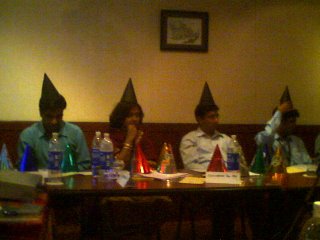 Black Hat
This is the hat of judgment and caution. The black hat is used to point out why a suggestion does not fit the facts, the available experience, the system in use, or the policy that is being followed. The black hat must always be logical.
 Yellow Hat
This is the logical positive. Why something will work and why it will offer benefits. It can be used in looking forward to the results of some proposed action, but can also be used to find something of value in what has already happened.
 Green Hat
This is the hat of creativity, alternatives, proposals, what is interesting, provocations and changes. The green hat is allowed to propose even ideas that may sound foolish.
 Blue Hat
This is the overview or process control hat. It looks not at the subject itself but at the 'thinking' about the subject. In technical terms, the blue hat is concerned with metacognition.
Roles of hats:
 White Hat
This covers facts, figures, information needs and gaps. White hat takes care of the arguments and proposals, and looks at the given data.
 Red Hat
This covers intuition, feelings and emotions. The red hat allows the thinker to put forward an intuition without any need to justify it. Usually feelings and intuition can only be introduced into a discussion if they are supported by logic. Usually the feeling is genuine but the logic is spurious. The red hat gives full permission to a thinker to put forward his or her feelings on the subject at the moment.
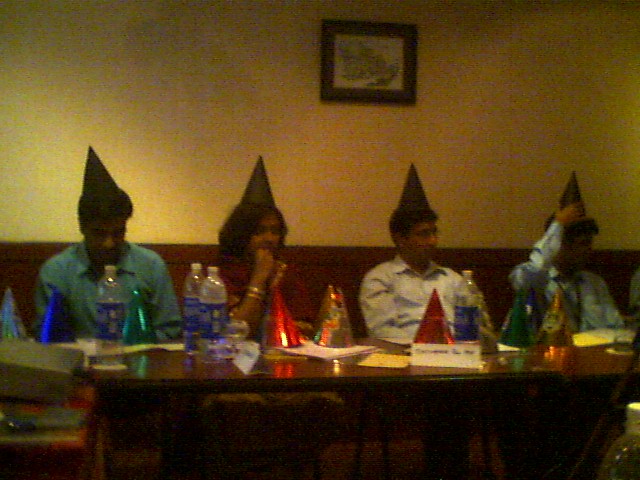 Black Hat
This is the hat of judgment and caution. The black hat is used to point out why a suggestion does not fit the facts, the available experience, the system in use, or the policy that is being followed. The black hat must always be logical.
 Yellow Hat
This is the logical positive. Why something will work and why it will offer benefits. It can be used in looking forward to the results of some proposed action, but can also be used to find something of value in what has already happened.
 Green Hat
This is the hat of creativity, alternatives, proposals, what is interesting, provocations and changes. The green hat is allowed to propose even ideas that may sound foolish.
 Blue Hat
This is the overview or process control hat. It looks not at the subject itself but at the 'thinking' about the subject. In technical terms, the blue hat is concerned with metacognition.
Subscribe to:
Posts (Atom)